
Last updated October 16, 2026
 Carriage house
 Full-view glass
 Chamberlain openers
Full 25-point door and opener safety check with every visit - springs, cables, rollers, tracks, and your LiftMaster or Chamberlain opener included
You get a price before we start. It does not change when the truck arrives.
Get your free estimateDIY vs Professional Garage Door: The Dallas Homeowner’s Decision Guide
YouTube hosts over 40,000 videos on garage door repair, and torsion spring replacement is the most-viewed category. It’s also the repair behind the majority of serious garage door injuries treated at Parkland Memorial and other Dallas trauma centers each year. That gap, between how easy a job looks on screen and how dangerous it actually is in your garage, is what this guide is about. We’ll draw a clear line: which tasks a mechanically comfortable Dallas homeowner can handle safely, which ones need a trained technician, and what each path really costs when you factor in tools, time, and the risk that doesn’t show up on a parts invoice.
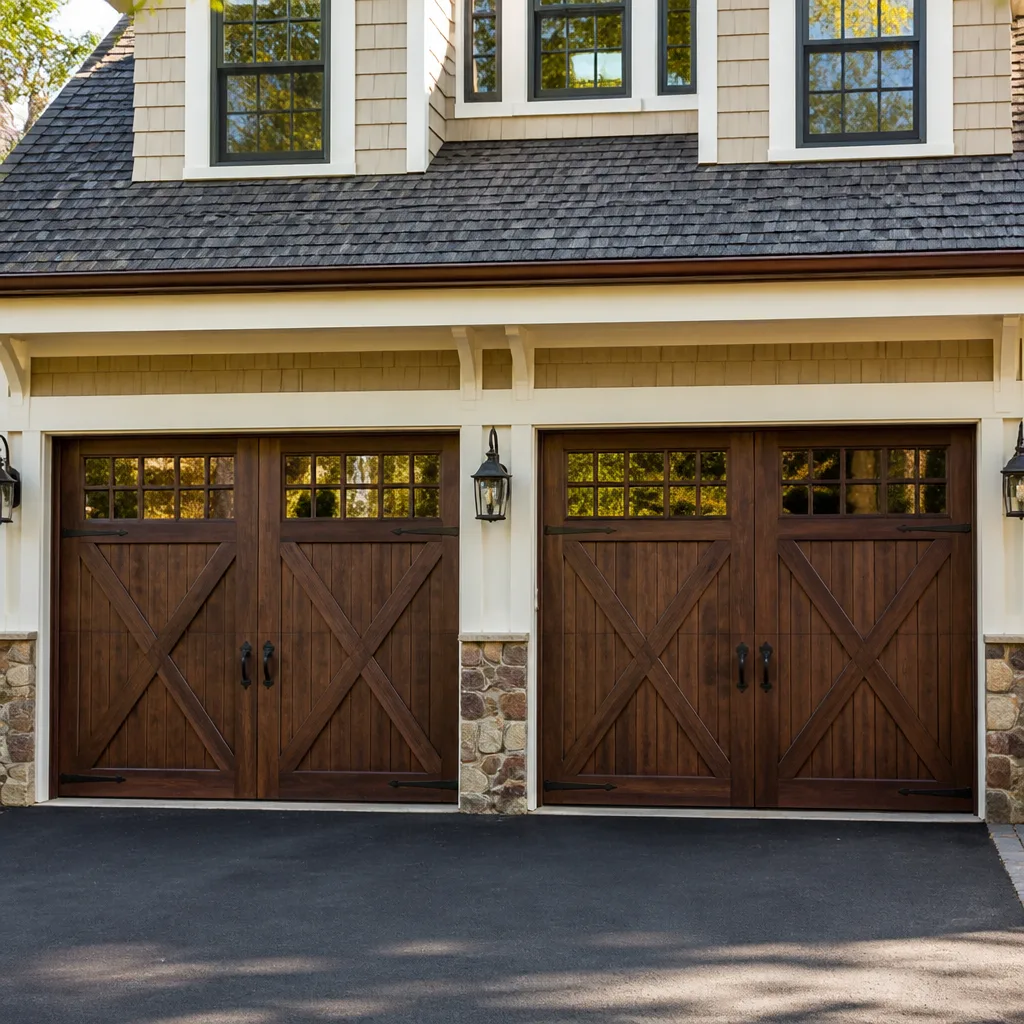
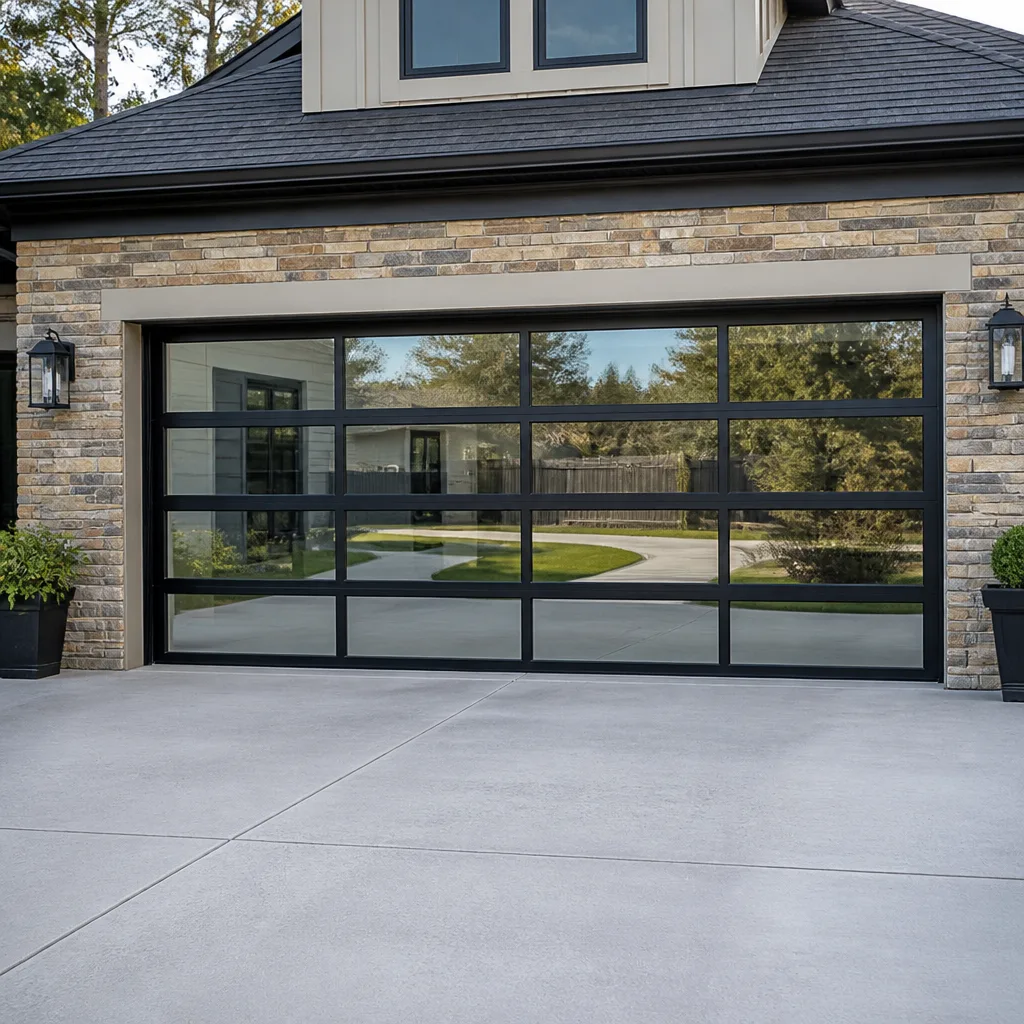
Styles & brands we work with
Quick Answer
For a Dallas homeowner, the DIY-vs-professional decision on a garage door comes down to one component: the torsion spring. Weather seals, rollers, keypads, and safety sensor alignment are reasonable DIY projects for someone comfortable with basic tools. Torsion springs, cable drums, and track work on heavy doors need professional tools and training because the stored tension in a single residential spring can exceed several hundred foot-pounds, enough to cause catastrophic injury if a winding bar slips. Everything else on the page explains that line in detail, including our Garage Door Cost Breakdown: The Dallas Homeowner’s Reference for 2026 and what to do if a DIY project stalls halfway.
Table of Contents
- The Torsion Spring Line: Where DIY Ends in Dallas
- DIY-Reasonable Tasks: What You Can Safely Handle
- Professional-Only Tasks: What Requires a Technician
- The Physics of a Torsion Spring, Stated Plainly
- The Real Cost Comparison: DIY vs Professional in Dallas
- How the Dallas Climate Affects DIY Garage Door Work
- What to Do When a DIY Attempt Stalls Mid-Job
- Common Mistakes to Avoid
- When to Call a Professional
- Frequently Asked Questions
- The Bottom Line
The Torsion Spring Line: Where DIY Ends in Dallas
The entire DIY-vs-professional debate on garage doors collapses into a single question: does the repair involve the torsion spring or the cable drums attached to it? If the answer is yes, the job belongs to a trained technician. If the answer is no, a homeowner with basic mechanical sense can handle most of what’s left. That’s not a cautious suggestion from an industry trade group. It’s the conclusion of every injury study done on residential garage doors in the last two decades, and it’s the line we draw on every service call we run in Dallas.
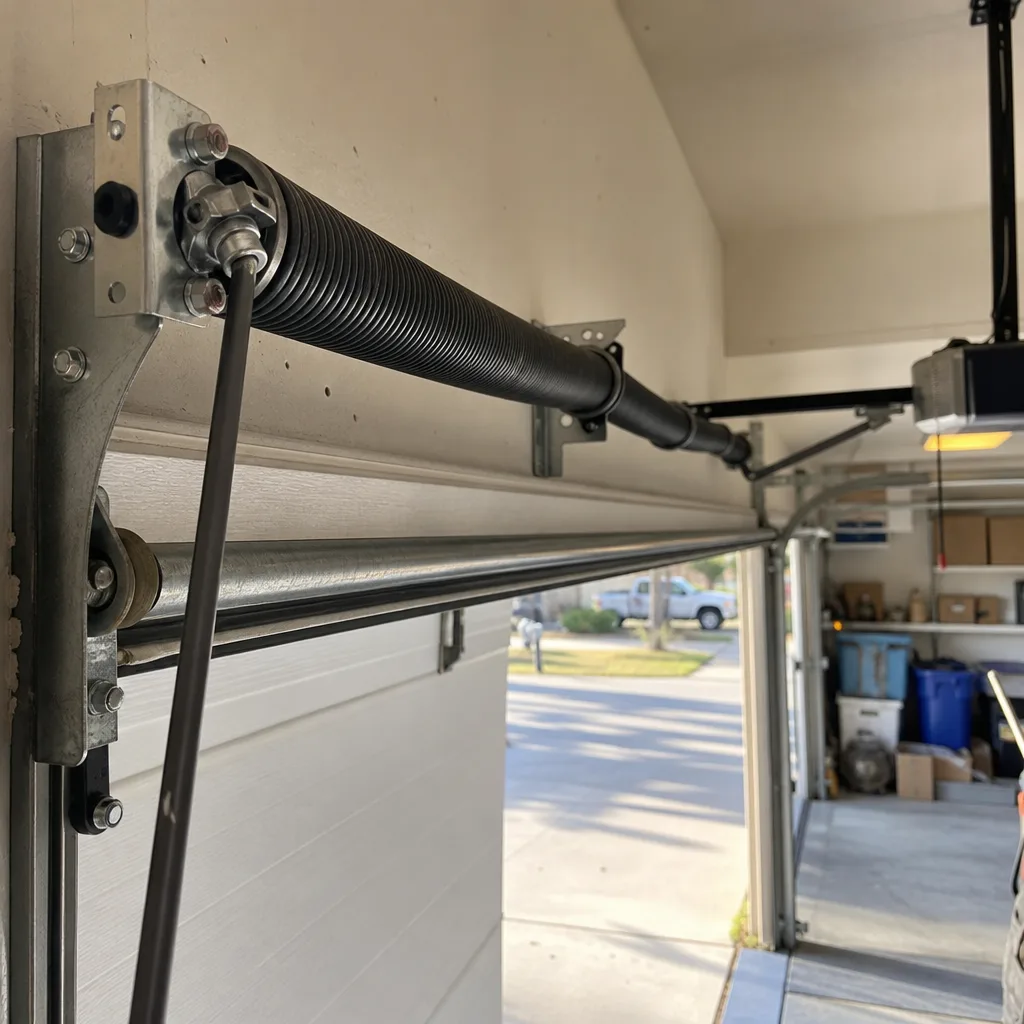
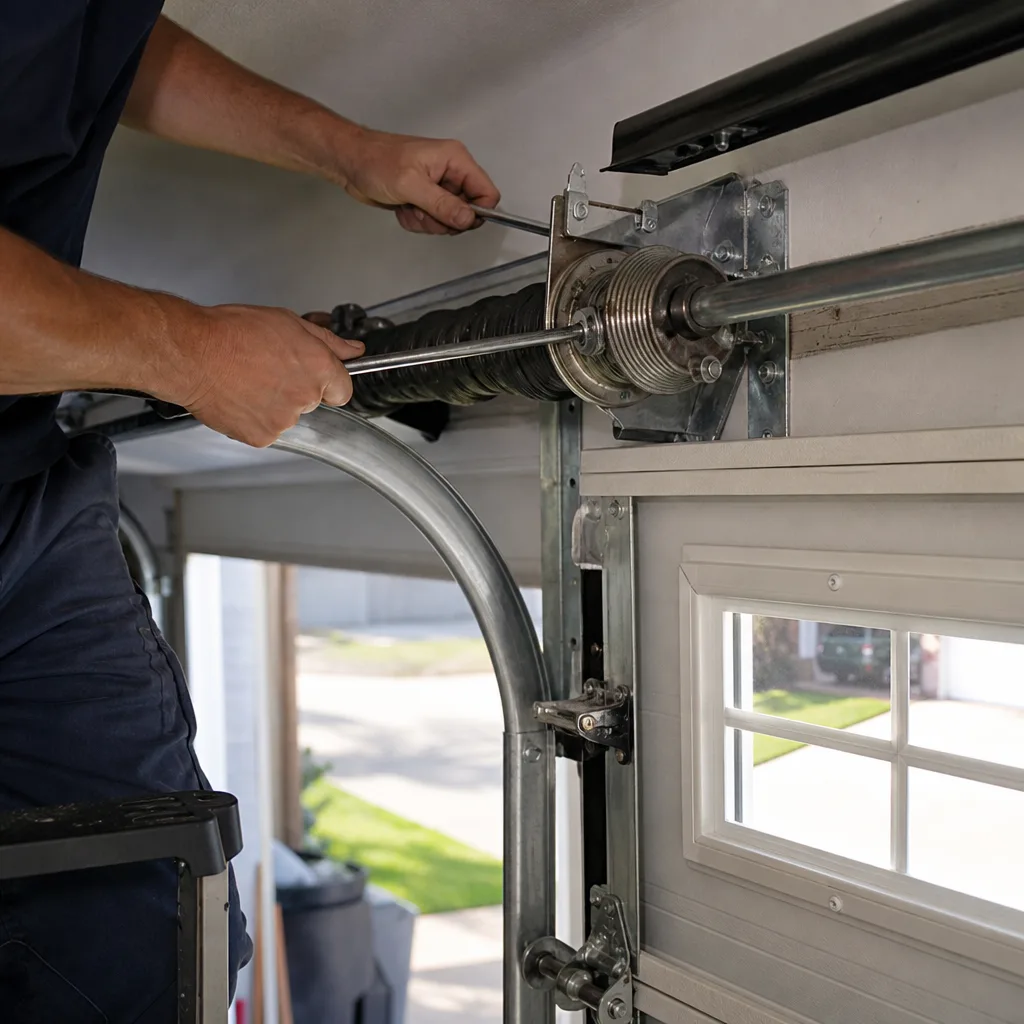
A torsion spring is the heavy coil mounted on a metal shaft directly above the closed door. It’s not a loose part you can remove. It’s wound tight under hundreds of pounds of stored torque, and that energy doesn’t care whether the person holding the winding bar has watched forty YouTube tutorials or none. When a spring lets go during a DIY attempt, the bar becomes a projectile and the door becomes a falling weight, often simultaneously. That’s the injury mechanism behind most of the garage door trauma cases that arrive at Garage Door Repair in Dallas emergency callbacks, where we’re asked to finish what started as a weekend project.
We’re not saying every component on a garage door is dangerous. Most aren’t, and we’ll cover those in the next section. But the spring is different in kind, not just degree. Every other part on your door is either unloaded (a bracket, a bolt, a seal) or carries a modest, manageable load (rollers, hinges, a trolley). The torsion spring is the only component on a standard residential door that stores enough energy to break bone. In our experience as a Dallas repair company, that’s the line homeowners need, stated without hedging: spring and cable work is professional territory, full stop.
If you want to understand the “why” behind that line, jump to the physics section. If you just want the practical list, the next two sections are your reference.
DIY-Reasonable Tasks: What You Can Safely Handle
Most of the maintenance and minor repair work on a garage door doesn’t involve the spring’s stored energy, and a patient homeowner can do these jobs well. The trade-off isn’t safety here; it’s time, patience, and having the right cheap parts on hand. Here’s the Garage Door Repair Maintenance Checklist for Dallas Homeowners we use to keep doors in good shape between professional service calls.
- Weather seal replacement (bottom and side seals): The rubber strip on the bottom of the door dries out and cracks in the Dallas heat, usually within three to five years. You’ll buy the replacement by the foot at any hardware store, pull the old one out of its channel, and slide the new one in. No tension anywhere on the door. Cost: $15-$40 in parts and about an hour.
- Roller replacement on unloaded doors: Steel or nylon rollers wear down and get noisy. On a door with torsion springs (the kind with the coil above the header), the rollers are under minimal load when the door is fully open, because the spring carries most of the weight. Popping a roller out of its hinge with the door open and sliding a new one in is straightforward for most standard 2-inch rollers. The one exception: never remove the bottom roller bracket on either side; those brackets are bolted to the cable system, and that’s not a DIY area.
- Keypad programming and remote syncing: Every opener brand uses a slightly different “learn button” sequence, but the steps are in the manual and take under five minutes. If you’ve lost the manual, the PDF is almost certainly on the manufacturer’s site. Nothing about this task touches the door’s weight or tension.
- Safety sensor alignment: The two small photo-eye sensors near the bottom of each track are designed to reverse the door when the beam is broken. Over time, a bump from a lawn mower or a car bumper can knock one out of alignment. Loosening the small wing nut, re-aiming the sensor until its indicator light glows steady, and re-tightening is a ten-minute job with no real hazard. This is also the most common false diagnosis a homeowner gets from online forums, where sensors get blamed for what’s actually a limit switch or circuit board problem.
- Lubrication: A silicone-based or white lithium lubricant applied to the rollers, hinges, and the torsion spring itself will keep a door quiet and extend part life. Avoid WD-40, which displaces moisture but provides no lasting lubrication. In Dallas, do this in the early morning or late evening during summer, which we cover in the climate section.
- Tightening loose bolts and brackets: Garage doors vibrate constantly, and nuts and bolts work loose over years of cycles. A socket set and ten minutes of methodically checking the hinge bolts, track brackets, and opener rail bolts will catch problems early. Leave the two bolts at the center of the torsion spring cone alone; those are under load and are not what they appear to be to an untrained eye.
None of these tasks require skill beyond what a person who hangs a ceiling fan or changes their own oil already has. The parts are cheap, the risk is low, and a mistake usually costs you another trip to the hardware store rather than a hospital bill.
Professional-Only Tasks: What Requires a Technician
The following repairs share two traits: they involve the stored energy in the spring or cable system, or they involve the full weight of the door moving through tracked metal. Both can maim or kill if something slips. We’ve listed them exactly as we’d explain them to a Dallas homeowner on the phone.
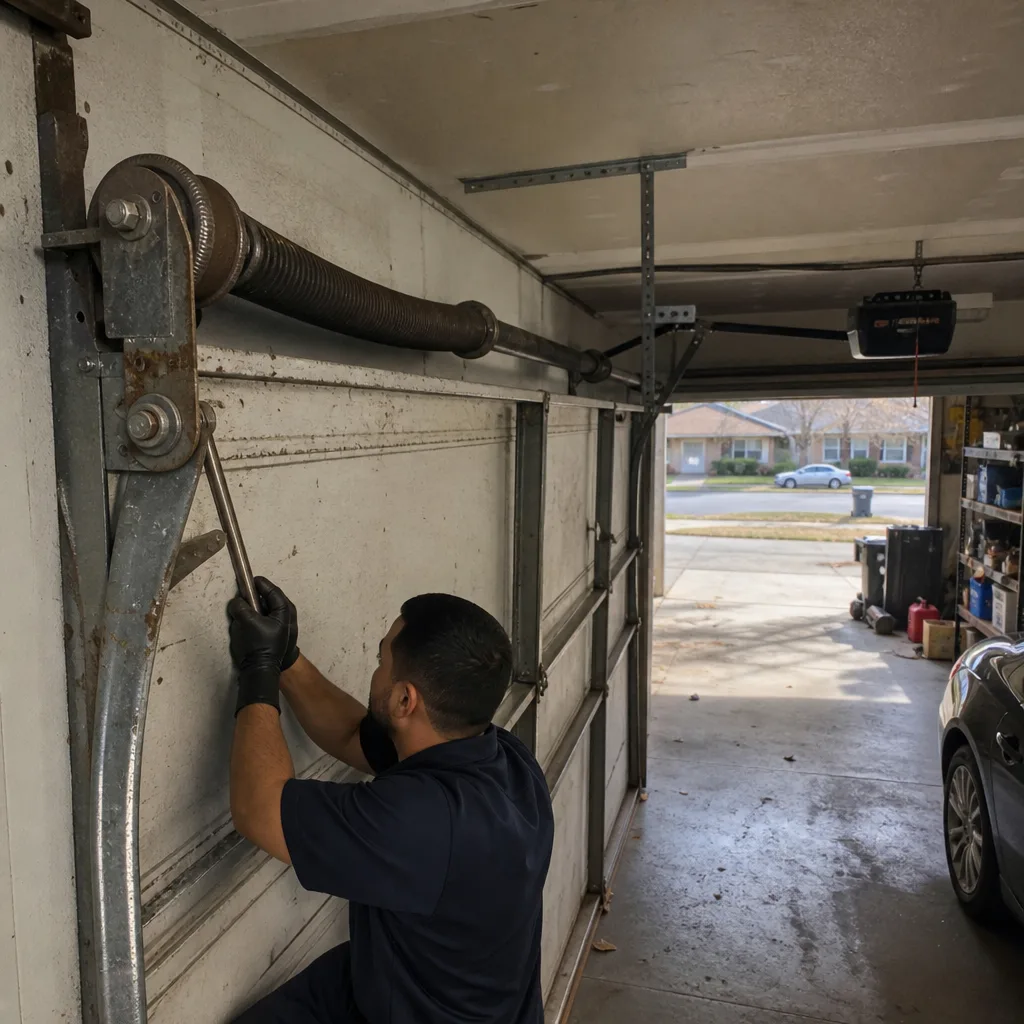
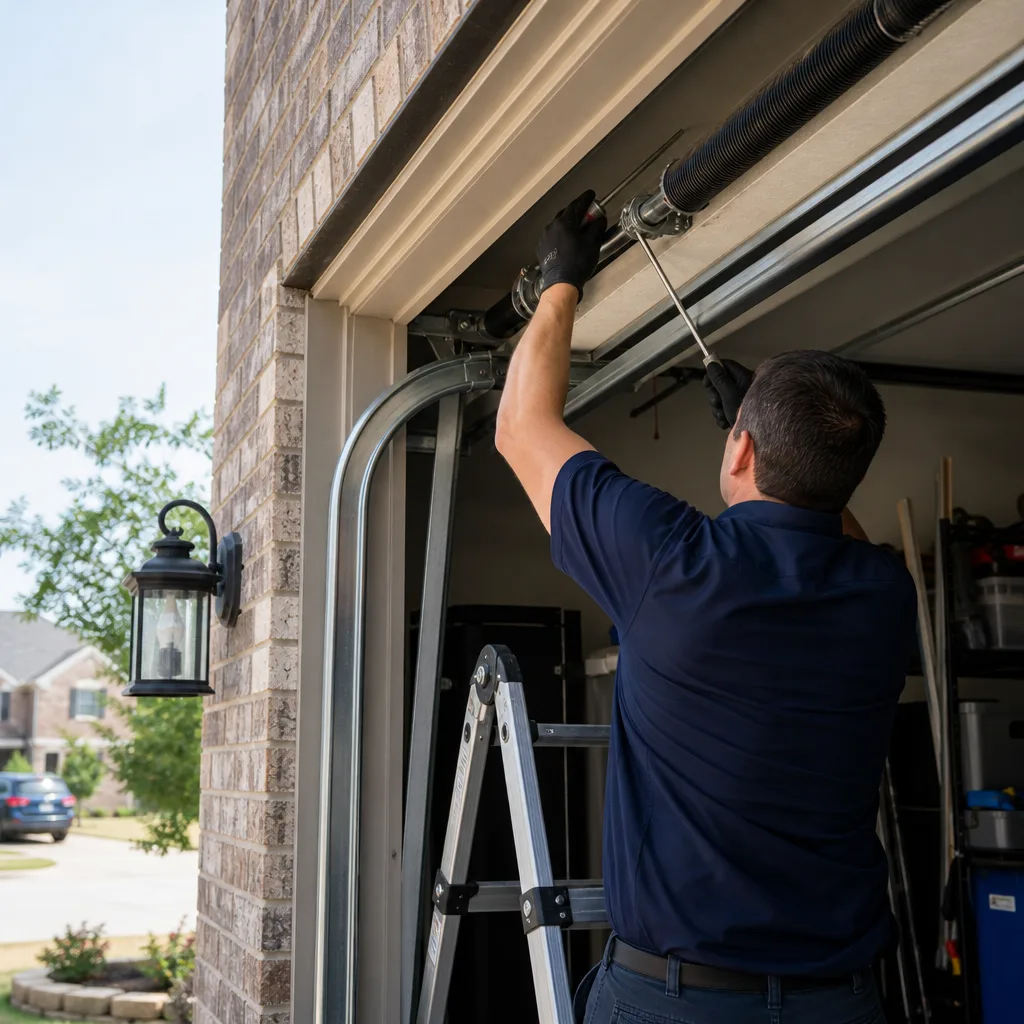
- Torsion spring replacement: This is the big one. A broken torsion spring means the door’s weight is no longer counterbalanced, so the door either won’t open or slams down when the release handle is pulled. Replacement requires winding the new spring to a specific tension, measured in quarter-turns, that varies by door height, spring wire size, and door weight. The two steel winding bars used to do this are under hundreds of pounds of load during the process. A slip means a metal bar traveling at high speed through whatever happens to be in its path. Most Dallas Garage Door Spring Repair in Dallas calls involve a spring that snapped mid-cycle, and the standard repair path is replacement of both springs as a matched set, not just the one that broke.
- Cable drum and cable replacement: The cables run from the bottom of the door up to drums at each end of the spring shaft. They carry the door’s full weight every time it moves. When a cable frays or jumps a drum, re-tensioning it properly means interacting with the same stored energy as the spring. This is not a job anyone does safely on their first attempt.
- Track replacement or major track adjustment on heavy doors: Bent or severely misaligned track on a steel or wood double door means loosening the brackets and realigning or replacing the rails. The door’s weight and the spring’s tension are both live during this process. A door that comes off its track can fall with its full weight. Wood doors in older Dallas neighborhoods like Lakewood or Kessler Park can exceed 400 pounds, and that weight doesn’t forgive a mistake.
- Opener replacement on doors with significant existing issues: Installing a new opener is sometimes DIY-legal on a door in perfect balance, but the truth is most Dallas opener replacements happen because the old opener burned out fighting a door that was already hard to lift. Installing a new motor on a door with a worn spring or bad rollers just transfers the strain to the new opener. A professional replacement includes checking and correcting the door’s balance as part of the job, which requires spring work most homeowners shouldn’t attempt.
- Any repair on a one-piece “California” style door: These tilting doors, still common in some mid-century Dallas homes, work on a completely different hinge and spring system. The tension geometry is different from a sectional door, and the failure mode throws the entire door outward. Most guides online assume a sectional door, and the instructions simply don’t transfer.
If a task on this list is what’s broken, the DIY question is answered. The remaining question is which professional to call, and we’ll address that at the end of this guide.
The Physics of a Torsion Spring, Stated Plainly
Here’s the number your YouTube video won’t tell you: a standard residential torsion spring on a typical two-car Dallas garage door, the kind installed on thousands of homes in Richardson, Plano, and McKinney, holds between 70 and 90 foot-pounds of torque per turn when fully wound. A standard spring for a 16-by-7-foot steel door takes about 30 to 36 quarter-turns on the winding cone, which means the spring stores roughly 2,100 to 3,200 inch-pounds of rotational force. In practical terms, that’s more stored energy than a .22 caliber rifle round carries at the muzzle, released all at once if the winding bar slips out of the cone.
What that means for a DIY decision: the tool you’d insert into that cone is an 18-inch half-inch steel winding bar. If the bar slips while you’re applying force, the spring unwinds instantly and the bar becomes a projectile moving at a speed that will crack bone or worse before you can react. That’s not an exaggeration for effect. It’s the injury mechanism documented in hospital records and in Garage Door Installation in Dallas service histories where we’ve replaced DIY-installed springs that failed within weeks.
The other physics problem is what the spring does when it breaks while the door is mid-travel. The door, without its counterbalance, becomes a dead weight of 150 to 350 pounds for a typical steel sectional. If the opener’s release handle has been pulled and the door isn’t in a locked position, that weight descends under gravity. The cable on the unbroken side yanks the door sideways, and the result is a door that’s jammed in its track, unbalanced, and heavy enough to pin someone. That’s the scene we arrive at on emergency calls where a homeowner tried to “just get it open” after a spring broke.
The takeaway isn’t that garage doors are dangerous in normal operation. They’re not; the failure of a properly maintained door is rare, and the safety systems built into openers since the early 1990s (the auto-reverse feature, the photo-eye sensors) have made the daily cycle very safe. The specific hazard is the repair moment, when the door’s balance system is being adjusted and a mistake has immediate, violent consequences. That’s the context a homeowner needs when deciding whether to wind a spring or call someone who does it every week.
The Real Cost Comparison: DIY vs Professional in Dallas
The honest arithmetic of DIY garage door repair looks different once you include the full invoice. Most online guides compare a $40 spring from a parts site against a $250 professional repair and call it a $210 savings. That math is fiction. Here’s what a DIY torsion spring attempt on a standard Dallas door actually costs, itemized.
DIY Torsion Spring Replacement: The Real Numbers
- Spring pair (correct wire size, inner diameter, and length for your specific door): $60-$110, assuming you correctly identify the existing spring’s dimensions from the painted code on the old one. If you guess wrong, the door won’t balance and you’ll buy a second pair.
- Winding bars (two required, 18-inch, half-inch diameter): $25-$40. These are not interchangeable with a screwdriver or a socket extension; using a random piece of round stock is how the projectiles get created.
- Vise grips or locking pliers to secure the door in place during the job: $15-$25.
- Time: A first-timer realistically spends 2 to 4 hours, including the trip to the hardware store, the YouTube re-watching, and the moments of standing there thinking about whether to continue.
- Risk: The part of the equation every DIY guide leaves out. A slip that sends you to the emergency room with a hand injury produces a bill that makes the professional repair look like a rounding error, even with insurance co-pays and deductibles doing part of the work.
Total realistic DIY cost: $100-$175 in parts and tools, plus a half day, plus whatever value you assign to not being injured.
Professional Torsion Spring Replacement: What Dallas Actually Pays
Most torsion spring replacements in the Dallas market run $150-$280, parts and labor included, for a standard two-car door with a matched pair of springs. That price includes the technician identifying the correct spring by measuring the old one rather than guessing, installing both springs, balancing the door, and testing the full cycle including the opener’s force settings. The written estimate you get before work starts is the price you pay when the job is done. Winding a spring incorrectly can leave the door unbalanced, which causes the opener to work harder, the new spring to fatigue early, and the door to slam or stick within months. A professional repair includes the adjustment as part of the installed price.
The real cost difference, then, is about $50 to $100, not $210. For that amount, a Dallas homeowner buys a spring that’s matched to the door, installed without a hospital visit, and covered by a written guarantee that says if it fails inside a year, the company comes back at no charge. That’s the calculus we think most people would choose if they saw it written down before the project started.
How the Dallas Climate Affects DIY Garage Door Work
Dallas doesn’t just heat up your garage; it changes the physics of the door you’re working on. Three specific climate factors matter for anyone doing DIY maintenance or repair.
Summer heat and metal expansion. A Dallas July day pushes garage temperatures past 100°F by noon, and that has a measurable effect on the steel in your door and track. Metal expands as it heats, which means the clearance between the door’s roller stems and the track tightens slightly. If you’re attempting track adjustments, do it in the early morning when the metal is at its coolest and closest to the temperature it’ll be during most of the operating year. Adjusting track at 3 p.m. in August means you’re setting clearances that will change by evening. The same principle applies to measuring for a replacement door: measure in the morning, not after the garage has baked all afternoon.
Lubricant behavior at 95°F. Garage door lubricants thin out in high heat. A lubricant applied to a hot spring or hot rollers runs off before it penetrates, which wastes the product and leaves the door noisy within weeks. Do lubrication work at dawn or after sunset when the metal has cooled, or use a lubricant specifically rated for high-temperature environments. The cheap general-purpose spray cans from the auto parts store are the worst offenders here.
Rubber degradation from UV and heat. Dallas gets an average of 232 sunny days a year, and the rubber seals on a west-facing garage door take direct afternoon sun that pushes surface temperatures well above the ambient air. Bottom seals crack and side seals shrink, which is why Dallas homeowners replace weather stripping more often than homeowners in northern markets. The good news is that this is one of the most DIY-friendly jobs on the whole door; the climate just means you’ll do it more frequently.
None of these factors make DIY work impossible in Dallas. They do change the timing and the products, and a homeowner who plans around them gets better results than one who fights the afternoon heat.
What to Do When a DIY Attempt Stalls Mid-Job
Every experienced technician has walked into a Dallas garage and found a door half-disassembled, a spring wound partway, or a door hanging by one cable because the homeowner got partway through and realized the job was beyond them. There’s no shame in that moment; there’s only the question of what to do next without making the situation worse. Here’s how to safely park a stalled DIY garage door project.
- Do not touch the spring or the cables. If the spring is partially wound or the cable is loose, the stored energy is now in an unpredictable state. Back away and don’t attempt to “finish” or “undo” the work.
- Secure the door in place. If the door is open or partially open, use C-clamps or locking pliers on the track just below the bottom roller on both sides. This physically blocks the door from moving down the track if the remaining tension lets go. Do this on both sides, not just one. If the door is closed and the spring is broken, use the opener’s pull cord to disengage the motor so it can’t be activated accidentally, and leave the door closed.
- Clear the area. Move cars, tools, and children out of the garage. A door that’s partially disassembled can fall or shift, and the area under and around it should be empty.
- Write down what you did. Before you call a technician, note exactly what you removed, what you loosened, what part broke, and what you were trying to accomplish. A technician who knows the starting point can assess the job in minutes rather than spending time reverse-engineering your work.
- Call a professional and explain the situation honestly. Tell the dispatcher the door is partially disassembled and no longer safe to operate. This changes the type of appointment they schedule and ensures the technician arrives with the right parts and the right expectation. Hiding the DIY attempt doesn’t save money; it just means the technician budgets time to diagnose a puzzle instead of to complete a known repair.
A good Dallas garage door company won’t judge a homeowner for attempting a repair and getting stuck. The Bramwell Garage Doors Dallas home team runs this exact call regularly, and the best practitioners of Garage Door Repair in Dallas treat a stalled DIY job as a normal service scenario, not a reason to lecture. What matters is that the door gets secured, the technician gets accurate information, and the repair gets finished correctly without anyone getting hurt.
Common Mistakes to Avoid
- Using the wrong tool for winding a spring. A screwdriver, rebar, a socket extension, or any round metal object that “fits” in the winding cone is not a winding bar. Real winding bars are solid steel, sized to the cone, and long enough to give you mechanical advantage. Improvised tools slip, and slipping is the injury event. This is the mistake behind a significant share of garage door injuries in Dallas emergency rooms.
- Replacing only one spring on a two-spring door. When one torsion spring breaks, the other one is almost always near the end of its cycle life too, because they’ve both cycled the same number of times. Replacing only the broken one leaves an old spring doing disproportionate work, which causes the new one to fatigue early and the door to run unbalanced. Professionals replace the pair.
- Adjusting the opener’s force settings to “fix” a heavy door. If your door has become hard to open, the problem is usually a worn spring or dry rollers. Cranking up the opener’s force dial makes the motor pull harder, which masks the symptom while burning out the motor and wearing the spring faster. The force setting should stay at the manufacturer’s recommended level.
- Disconnecting the opener while the door is open, expecting it to stay put. If the spring is broken or weak, the door’s full weight transfers to the cables, or worse, to nothing. Pulling the red release handle on a door with a broken spring can turn a closed door into a falling one. Never pull the release unless the door is fully closed or you know the spring is intact.
- Skipping the balance test after any roller, track, or cable repair. A properly balanced door should stay in place when opened halfway and released, neither rising nor falling on its own. If a DIY repair leaves the door unbalanced, the opener works against the imbalance every cycle and components fail early.
- Measuring a replacement door or part in the afternoon heat. As covered in the climate section, a hot garage changes metal dimensions. Measure in the morning or account for expansion, especially on track work and weather stripping.
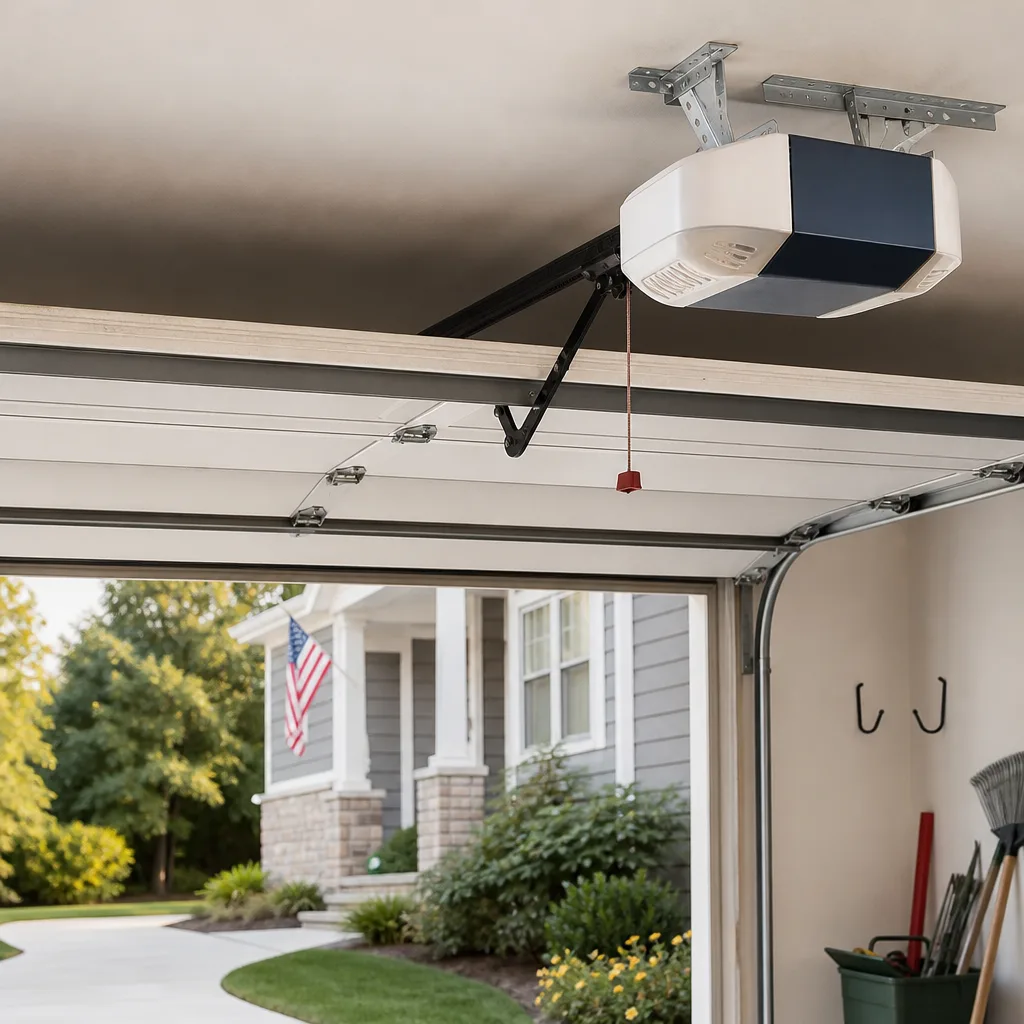
- Assuming all openers use the same programming sequence. Genie and Chamberlain, the two most common brands in Dallas homes, use completely different learn-button procedures and different remote protocols. Following the wrong brand’s instructions wastes an hour and won’t pair the remote. Use the manual for your specific opener.
When to Call a Professional
The clearest signal is a broken spring or a frayed cable. If the door won’t open at all and the spring above the door is visibly split into two pieces, the decision is made. If a cable has unraveled from its drum or is hanging loose, same answer. A door that slams when the release handle is pulled is telling you the balance system has failed. If you hear a loud bang from the garage and the door no longer lifts, that’s a spring. If the door opens unevenly, with one side lagging, that’s a cable or track problem, not an opener problem.
If you’re in Dallas and any of these signs match what you’re seeing, call (361) 240-9428. Bramwell Garage Doors Dallas offers free estimates on all garage door repairs, and a live person answers the phone 24 hours a day. We’ll tell you over the phone what we think the problem is, and we’ll put a written price in front of you before any work starts.
Frequently Asked Questions
You physically can, but you should not. Torsion springs store hundreds of pounds of torque, and a winding bar slip during installation is the leading cause of serious garage door injury in the Dallas area. The cost savings over a professional repair, once you factor in the correct tools and the genuine risk of injury, amounts to roughly $50-$100. Our recommendation is to hire a licensed professional for spring work and reserve DIY effort for weather seals, rollers, sensors, and lubrication.
Most torsion spring replacements in the Dallas market run $150-$280, parts and labor included, for a standard two-car door with a matched pair of springs. The exact price depends on the spring’s wire size, the door’s weight and height, and whether additional components like cables or bearing plates need replacement. Bramwell Garage Doors Dallas provides a written price before any work starts, so the number you hear is the number you pay. Call (361) 240-9428 for an exact quote, estimates are free.
You can safely replace bottom and side weather seals, swap most rollers with the door in the open position, program keypads and remotes, align safety sensors, lubricate moving parts, and tighten loose bolts. None of these tasks involve the spring’s stored tension or the door’s full weight coming off its track. Avoid any work involving the torsion spring, the cable drums, or the bottom roller brackets, which are bolted to the cable system.
No. A broken spring means the door’s weight is no longer counterbalanced, and the opener motor is not designed to lift the full weight of the door. If you pull the red release handle with the door raised, the door can fall. If you keep operating the opener, the motor will burn out and the door can jam unevenly. Disengage the opener, leave the door where it is, and call for professional repair. If the door must be opened before a technician arrives, tell the dispatcher when you call; they’ll advise you on how to do it without releasing stored energy.
Heat, humidity swings, and frequent cycling all shorten spring life, and Dallas gets all three. Most residential torsion springs are rated for roughly 10,000 cycles, which translates to seven to ten years of normal use, but the temperature swings in a North Texas garage accelerate metal fatigue. A spring that lives its whole life in a 100°F-plus garage in July and a 40°F garage in February simply wears out faster than one in a mild coastal climate. This is why we recommend replacing both springs as a matched set when one fails, even if only one has broken.
No. Estimates for garage door repair, spring replacement, and new door installation in Dallas are free. A technician will assess the door, explain what’s wrong in plain language, and hand you a written price before any work begins. If you decide the repair fits your budget, we do the work on the spot. If not, you pay nothing for the visit. Call (361) 240-9428 to schedule a free estimate.
The Bottom Line
The DIY-vs-professional garage door decision in Dallas comes down to a line that’s easy to state and easy to ignore: the spring and its cables are professional territory, and nearly everything else is fair game for a patient homeowner looking for more guides & resources. Weather seals crack faster in the Dallas sun, rollers wear out from daily use, and sensors need realignment after a bump; those jobs are genuine money-savers for someone with a socket set and an hour. The spring, the cables, and the track are different. They hold enough stored energy to cause life-changing injury, and the tools and training to work on them safely cost more than the professional repair itself. If your spring has broken, call a professional. It’s the one decision in this guide we’d tell a neighbor not to think twice about.
Written by Marcus Ellery, Owner at Bramwell Garage Doors Dallas, serving Dallas since 2001.
See the difference
 Before
 After
After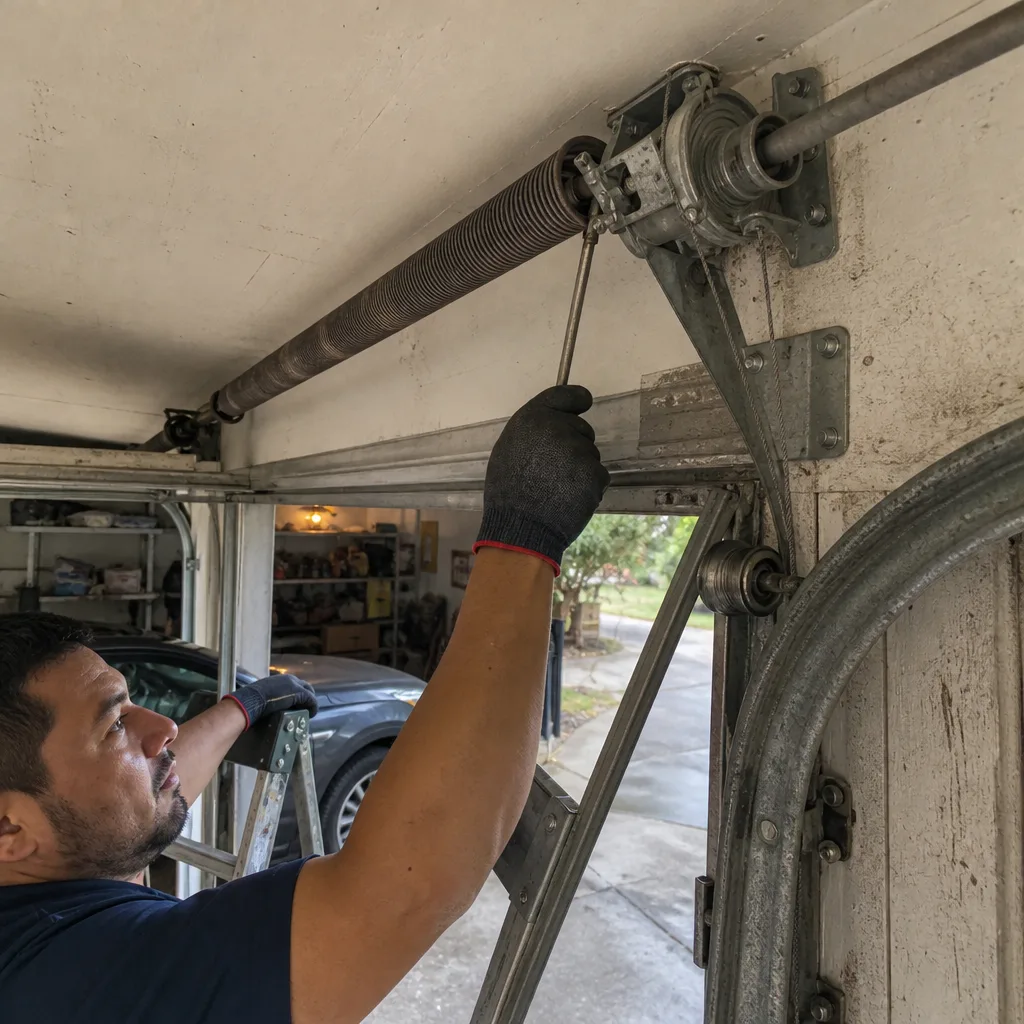 Before
 After
After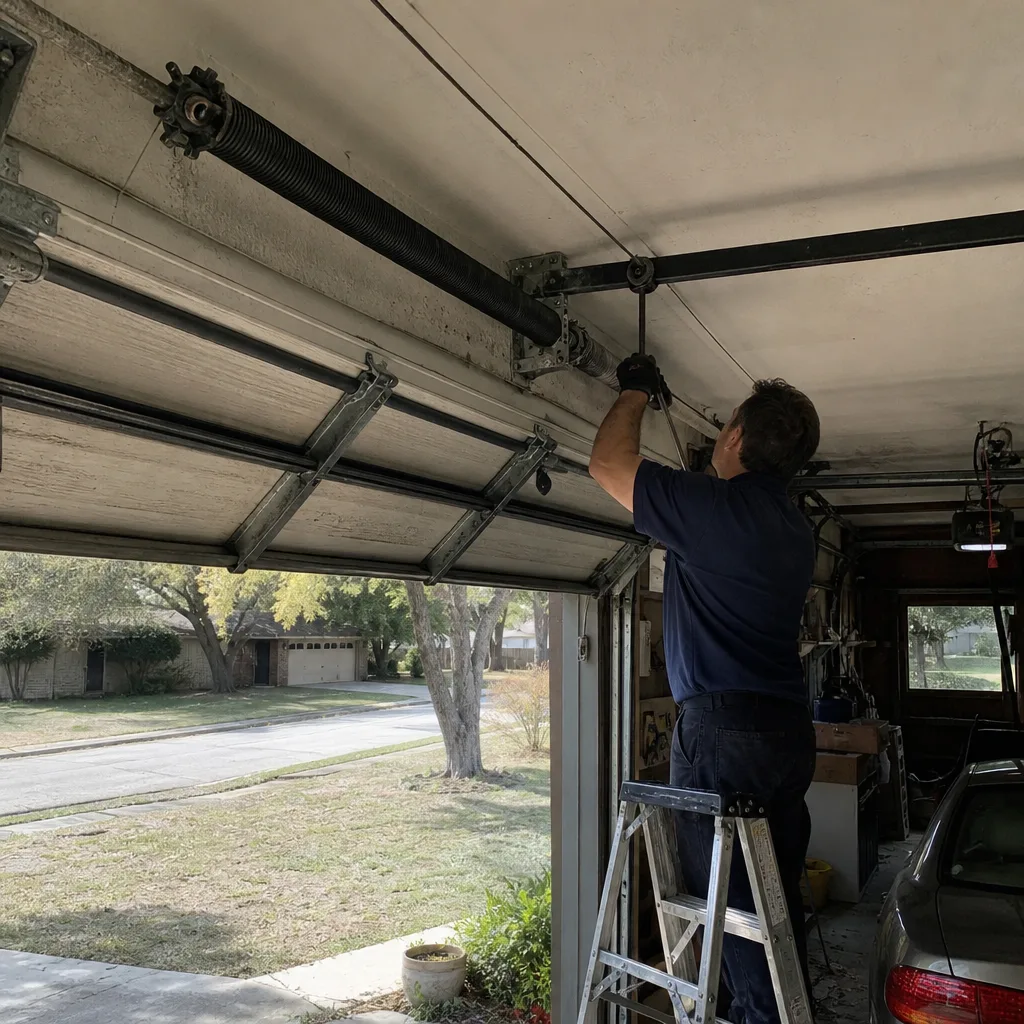 Before
 After
After